
Appliance repair cost and what to expect from a repair visit
Sourced national repair-cost ranges for refrigerators, washers, dryers, dishwashers, and ranges, typical service call fees, and how a repair visit works.
By Appliance Insider Editorial Team · Updated October 3, 2026
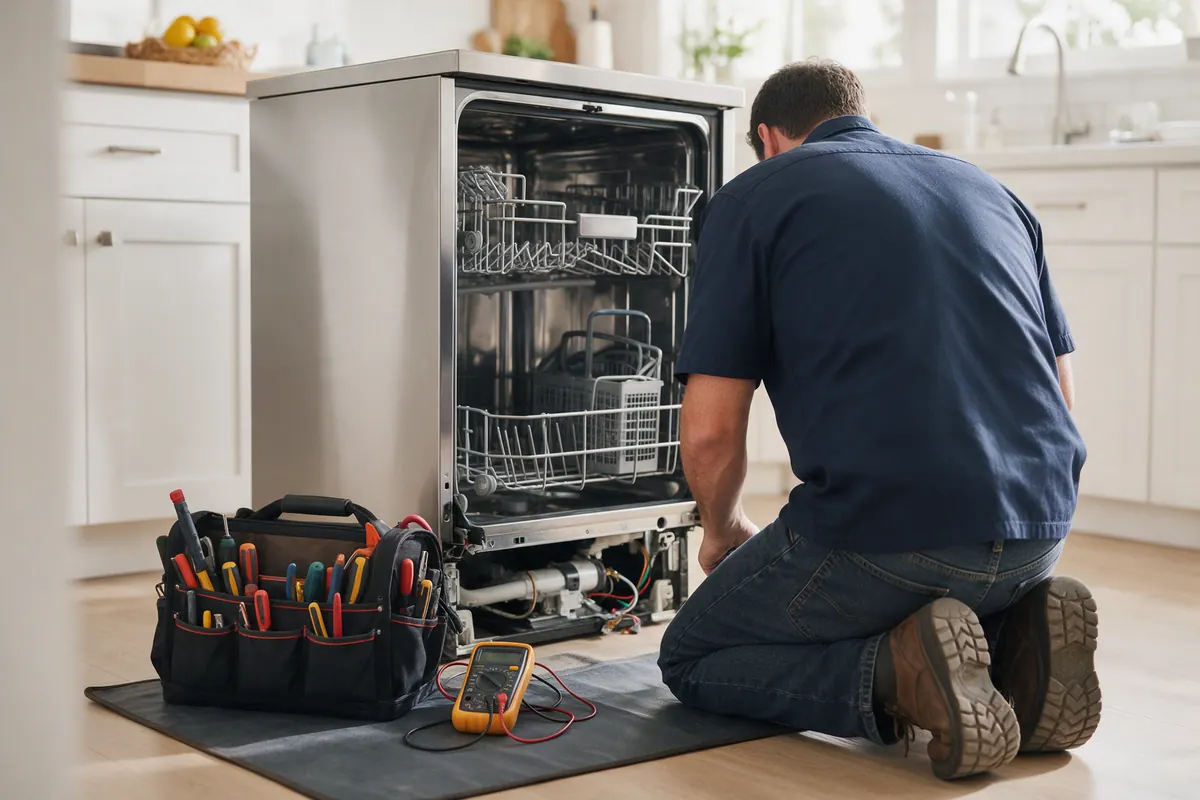
Short answer: most appliance repairs cost a few hundred dollars. HomeGuide puts the typical range at $100 to $400, with a $70 to $130 service call that usually includes diagnosis and the first hour of labor. HomeAdvisor reports a typical range of $108 to $251 and an average of $179. The appliance, the failed part, your brand, and local labor rates move the number most.
Repair cost by appliance
| Appliance | Typical repair range | Average | Notes | Source |
|---|---|---|---|---|
| Refrigerator | $150–$400 | $275 average | Angi lists control boards at $200–$500 and sealed-system work (compressor, refrigerant) as the costly end. | Angi |
| Dishwasher | $175–$325 | $225 average | Angi: drainage repairs $100–$250, pump replacement $150–$350, motor replacement $250–$600. | Angi |
| Washing machine | $180–$250 | $220 average | Angi: pump replacement $150–$400, motor work $250–$700. | Angi |
| Dryer | $100–$430 | $180 average | Angi suggests budgeting $150–$300 more if the dryer vent also needs work. | Angi |
| Oven, cooktop, or range | $100–$500 | — | Angi | |
| Freezer | $90–$500 | — | Angi | |
| Microwave | $50–$400 | — | Angi | |
| Garbage disposal | $70–$250 | — | Angi |
Service call, diagnostic, and labor fees
- Service call / diagnostic fee: $70 to $130 is typical, usually covering travel within the standard service area, diagnosis, and the first hour of labor (HomeGuide). Angi's dishwasher guide lists minimum service and diagnostic charges of about $50 to $80.
- Labor: about $50 to $125 per hour beyond the first hour (HomeGuide).
- Emergency, after-hours, or holiday service: HomeGuide lists $140 to $400 for an emergency call-out.
- Parts: billed on top of labor. Special-order parts can add shipping and a second trip.
What makes a repair cost more
- The part that failed. Door gaskets, belts, and igniters are at the low end; control boards, motors, and refrigerator sealed-system work are at the high end.
- Brand and model. Premium and built-in models often use proprietary parts and take longer to service.
- Access. A built-in refrigerator or a stacked laundry pair takes more labor than a freestanding unit.
- Where you live. Labor rates and travel charges vary by region, and service outside a company's standard area can cost extra.
- Timing. Same-day, weekend, and holiday visits cost more than scheduled weekday visits.
What to expect from a repair visit
- Before you call: do the free checks first. Many "broken" appliances have a tripped breaker, a closed water valve, a clogged filter, or a control lock turned on. Start with our error code hub and troubleshooting guides.
- Booking: have the model and serial numbers (from the rating label), the exact error code if any, and a short description of the symptom ready. Ask what the service call includes and whether it is credited toward the repair.
- Diagnosis: the technician tests the appliance and identifies the failed part, then gives you an estimate. Ask for it in writing before approving work.
- Repair: if the part is on the truck, many repairs are completed in the same visit. If it must be ordered, the technician returns once it arrives.
- After the repair: ask what the parts and labor guarantee covers and for how long, and keep the invoice with your appliance records.
How to save on appliance repair
- Check whether the appliance is still under the manufacturer's warranty or an extended plan before paying for service.
- Compare the estimate with the appliance's age and expected life using our appliance lifespan chart and the repair-or-replace guide.
- Schedule non-urgent repairs on weekdays to avoid emergency rates.
- Prevent repeat calls with routine maintenance from our maintenance calendar.
Questions to ask a repair company
- What does your service call or minimum fee include, and is it credited toward the repair?
- Am I inside your standard service area, or will there be travel charges?
- Do you work on my brand, and do you carry common parts for it?
- What guarantee do you give on parts and labor?
- Will I get a written estimate before any work begins?
Appliance repair cost FAQ
How much does an appliance repair usually cost?
National cost guides put most appliance repairs between roughly $100 and $400. HomeGuide lists $100 to $400 on average, and HomeAdvisor reports a typical range of $108 to $251 with an average of $179. Your price depends on the part, the brand, and local labor rates.
How much is an appliance repair service call?
HomeGuide puts a typical appliance repair service call at $70 to $130, usually covering travel in the standard service area, diagnosis, and the first hour of labor. Emergency, after-hours, or holiday calls cost more; HomeGuide lists $140 to $400 for emergency call-outs.
Is the diagnostic fee applied to the repair?
Often, but not always. Many repair companies credit the service call or diagnostic fee toward the repair if you approve the work, while others charge it separately. Ask how the fee works before you book, and get the estimate in writing before any work begins.
How long does an appliance repair take?
Many repairs are finished in a single visit when the technician carries the part. If a part has to be ordered, expect a diagnostic visit and then a second visit once the part arrives, and how long that takes depends on part availability for your model. Ask the company whether the part is in stock when they give you the estimate.
Which appliance repairs are usually not worth it?
Expensive repairs on appliances near the end of their typical life are the usual candidates for replacement, such as a refrigerator sealed-system or compressor repair on an older unit. A common rule of thumb is to replace when the repair would cost about half the price of a comparable new model.
Sources
Cost figures were checked on October 3, 2026.
- HomeGuide: How Much Does Appliance Repair Cost? (2026)
- HomeAdvisor: How Much Does Appliance Repair Cost?
- Angi: How Much Does Refrigerator Repair Cost? [2026 Data]
- Angi: How Much Does Dishwasher Repair Cost? [2026 Data] (updated Apr 6, 2026)
- Angi: How Much Does It Cost to Repair a Washing Machine? [2026 Data]
- Angi: How Much Does Dryer Repair Cost? [2026 Data]
- Angi: Appliance repair pros near me (average repair costs by appliance)