Roborock Saros 20 Sonic vs. Flow vs. Neo: Vibrating Pad, Roller or Spinning Pads?
Saros 20 Neo vs. Sonic vs. Flow: same 36,000 Pa suction, three mop styles. Specs, test results, the Neo's US name, and who should buy which one.
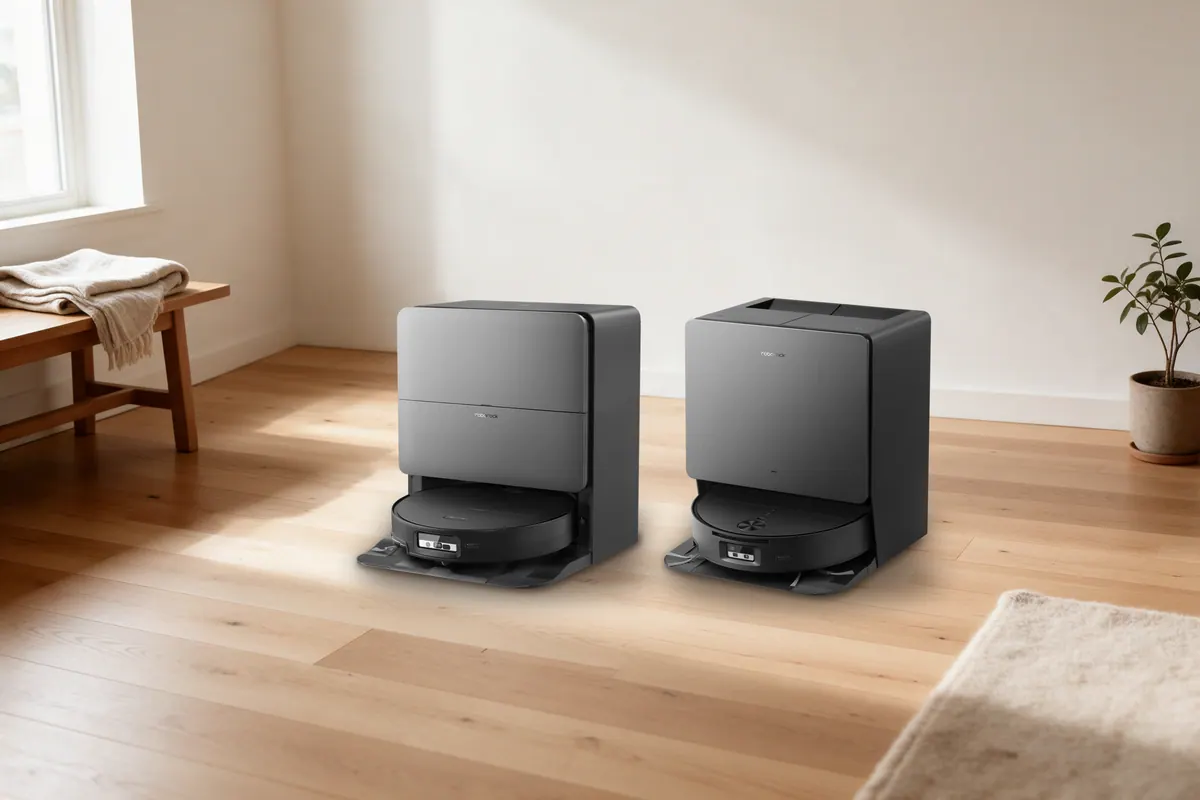
In the Roborock Saros 20 Sonic vs. Saros 20 Flow matchup, pick the Sonic if you need the slimmest robot for low furniture or care most about vacuuming, and pick the Flow if your home is mostly hard floors and you want a mop that rinses itself with clean water as it works. Both are rated at the same 36,000 Pa of suction and share most of their navigation and dock features. The real split is the mop, plus one practical catch: as of Oct. 18, 2026, the Sonic is out of stock at Roborock and Amazon, and the Flow is the one you can actually buy.
Searching for the Saros 20 Neo vs. Sonic? The Neo is the third Saros 20 variant, with two spinning mop pads instead of a vibrating pad or a roller. It launched in Europe, and in the US it appears to be sold as the Roborock Qrevo Edge 3 Pro. We cover it in its own section below.
This is a research-based comparison built from Roborock’s spec pages and published testing by Netzwelt, Vacuum Wars, Vacubots, and Trusted Reviews. We have not tested these robots ourselves, so there is no rating here.
Saros 20 Sonic vs. Flow vs. Neo at a glance
| Saros 20 Sonic | Saros 20 Flow | Saros 20 Neo (US: Qrevo Edge 3 Pro) | |
|---|---|---|---|
| Mop system | VibraRise 5.0 vibrating pad | SpiraFlow 2.0 roller mop | Two spinning microfiber pads; one swings out (FlexiArm) |
| Mop specs (Roborock) | 4,000 vibrations/min, 14 N downward pressure, extendable mop | 270 mm roller, up to 240 RPM, up to 15 N, 16 pressurized clean-water outlets | 200 RPM, up to 14 N downward pressure |
| Rated suction | 36,000 Pa | 36,000 Pa | 36,000 Pa |
| Robot size | 350 x 353 x 79.8 mm (3.13 in tall) | 353 x 353 x 89.8 mm (3.54 in tall) | 352 x 350 x 79.8 mm (3.14 in tall) |
| Thresholds (Roborock) | 4.5 cm single; 4.5 + 4.3 cm double (3.46 in total) | 4.5 + 4.3 cm double (3.46 in total), with a climbing arm | 4.5 + 4.3 cm double (3.46 in total), with a climbing arm (AdaptiLift Chassis 3.0) |
| Carpet handling | Mop detaches or lifts on carpet | Roller lifts up to 15 mm, with an automatic roller shield | Pads lift or detach in the dock; chassis adjusts on carpet up to 3 cm (1.18 in) pile |
| Battery | 6,400 mAh; up to 180 min (Vac & Mop, Balanced) | 6,400 mAh; Roborock quotes coverage up to 200 m² | Not on the Roborock pages we checked; Trusted Reviews lists up to 256 min |
| Dock mop wash / dry | Up to 212°F (100°C) wash; 131°F (55°C) warm air | Up to 212°F (100°C) wash; 145°F (63°C) warm air | Up to 212°F (100°C) wash; 131°F (55°C) warm air |
| Dock size (as listed) | 440 x 409 x 470 mm | 381 x 454 x 451 mm | 402 x 494 x 450 mm |
| Auto-empty | Up to 65 days | Up to 65 days | Up to 65 days |
| Wi-Fi (per Roborock’s Amazon listings) | 2.4 GHz and 5 GHz | 2.4 GHz only | Not verified |
| US warranty | 1 year limited | 1 year limited | 1 year limited (as the Qrevo Edge 3 Pro) |
Figures are Roborock’s own, from its US, global, and Singapore product pages; the Neo’s come from Roborock’s UK Saros 20 Neo page and its US Qrevo Edge 3 Pro page, which list the same numbers. Suction, threshold, and coverage numbers come from Roborock’s internal testing.
What’s the difference between the Sonic and Flow mops?
The Saros 20 Sonic scrubs with a flat pad that vibrates. Roborock rates VibraRise 5.0 at 4,000 vibrations per minute and 14 N of downward pressure, and says this version drops the separate edge-mopping module in favor of a mop that extends toward walls and corners. In vacuum-only mode on carpet, the robot can leave the pad behind in the dock, and the dock can wash that pad while the robot keeps vacuuming.
The Saros 20 Flow uses a spinning roller instead of pads. Roborock says SpiraFlow 2.0 sprays clean water onto the 270 mm roller through 16 pressurized outlets while it turns at up to 240 RPM, and collects the dirty water separately in the robot’s own dirty-water tank. The idea is that the robot keeps mopping with a freshly rinsed surface rather than dragging a pad that gets dirtier as it goes. Roborock also says the dock refills the robot with warm water after each mop wash, and that the roller mops within 10 mm of edges and can extend up to 44 mm.
Practically, that means the Flow has more wet parts on the robot itself (a clean-water supply, a dirty-water tank, and a roller to rinse), while the Sonic leaves more of the dirty work to the dock.
Which one mops better? What testers found
The best direct evidence comes from Netzwelt, a German tech site that tested the Saros 20 Neo, Sonic, and Flow side by side (European versions, Sept. 12, 2026):
- Dried stains: both the Sonic and the Flow removed dried coffee and ketchup completely. Netzwelt found the Sonic a touch more effective on dried stains on wood.
- Edges: in its test, the Flow’s extending roller reached to about 0.6 cm from the edge, and the Sonic’s extending mop to about 1 cm.
- Corners: the Sonic’s extending side brush cleaned all the way into corners. The Flow’s side brush lifts out of the way while mopping but does not extend, and left a small amount of debris in the corner.
- Hygiene: Netzwelt gave the Flow the edge because the roller is rinsed continuously, and recommended it for people who prioritize hygienic floors.
Netzwelt scored all three almost identically overall: 1.3 for the Flow, 1.3 for the Neo, and 1.4 for the Sonic on the German school-grade scale, where lower is better. Its Neo findings are in the next section.
Vacuum Wars has published test results for the Sonic but not, as of Oct. 18, 2026, for the Flow. Its Sonic summary is less flattering on mopping: it rated dried-stain removal and combined vacuum-and-mop performance well below average. That disagrees with Netzwelt’s stain result, which is a good reminder that mopping tests vary a lot by method. Treat both as data points, not a final answer.
Where does the Saros 20 Neo fit?
The Saros 20 Neo is the same 36,000 Pa Saros 20 platform with a third mop style: two round microfiber pads that spin at up to 200 RPM with up to 14 N of downward pressure, per Roborock. One pad swings out on a FlexiArm to reach along walls and under toe-kicks, and the dock can keep the pads behind when the robot vacuums carpet. Roborock lists the robot at 352 x 350 x 79.8 mm, the same slim height as the Sonic, with a retractable LiDAR sensor that drops down for low furniture.
US name. Roborock’s US store has no Saros 20 Neo page that we could find. Stuff reports that the Neo is sold in the US as the Qrevo Edge 3 Pro, and Roborock’s US Qrevo Edge 3 Pro page matches Roborock’s UK Saros 20 Neo page spec for spec: the same robot and dock dimensions, 36,000 Pa, 200 RPM pads, 14 N, 212°F mop washing, 131°F drying, and carpet adjustment up to 1.18 inches. Check the model name on the listing you buy from, since the Neo name is mainly used outside the US.
What testers found:
- Netzwelt (Germany, Sept. 12, 2026): the Neo mopped closest to walls, edges, and hard-to-reach gaps of the three, and Netzwelt said only the Neo got all the way to the wall. The Sonic removed dried stains on wood slightly better than the Neo. Netzwelt saw little deep cleaning on carpet from all three models.
- Trusted Reviews (UK, Oct. 27, 2026): the Neo picked up all of a 20 g flour spill on test carpet in two passes, removed coffee and red wine stains in two passes, and reduced dried ketchup a lot but needed a spray of kitchen cleaner to finish it. It measured 58.3 dB. Its complaints: the water tanks must come out to reach the dust bag and detergent, and the LiDAR dome has to retract to get under furniture, which slows navigation a little.
In short, the Neo trades the Flow’s continuously rinsed roller and the Sonic’s vibrating pad for conventional spinning pads that reach edges well. On Roborock’s US store it was also the cheapest of the three on Nov. 16, 2026.
Vacuuming, carpet, and pet hair
On paper, there’s no vacuuming difference. Both robots are rated at 36,000 Pa and use the same DuoDivide main brush with an anti-tangle side brush. Roborock says the system handles hair up to 15.75 inches without tangling.
Testing so far mostly covers the Sonic:
- Vacuum Wars measured 92% in its carpet deep-clean test, which it called the fourth-highest result it has recorded, and gave the brushes a perfect score in its tangle test with 7-inch hair.
- The same testing found pet-hair pickup of only 78% and a dustbin much smaller than average.
- Netzwelt found little deep cleaning on carpet from all three Saros 20 models, Sonic and Flow included.
- Vacubots’ early hands-on with the Flow (Oct. 8, 2026) reported good vacuuming on engineered hardwood, average results on tile, and mediocre to poor results on medium-pile carpet in its first runs.
If carpet is most of your floor space, neither model’s mop is the reason to buy it, and you’ll be paying for mopping hardware you rarely use. Roborock’s own base Saros 20 with dual spinning pads, or a dedicated vacuum, may make more sense.
Height, thresholds, and navigation
This is where the Sonic has a real, measurable advantage. With its LiDAR retracted, Roborock lists the Sonic at 79.8 mm (3.13 in) and the Flow at 89.8 mm (3.54 in). That 1 cm matters under low sofas, beds, and media cabinets. The Neo lists the same 79.8 mm height as the Sonic. Measure your lowest gap before you choose.
Both robots cross double-layer thresholds up to 4.5 cm plus 4.3 cm, which Roborock totals as 3.46 inches. The Flow does it with a climbing arm Roborock calls AdaptiLift Traverse 3.0. Vacuum Wars measured the Sonic clearing a 57 mm single threshold, tying the best result it has recorded.
Both use Roborock’s retractable LiDAR, a 100-degree rear view, an RGB camera, and side-facing VertiBeam structured light, and Roborock says both recognize more than 300 object types. In testing:
- Vacuum Wars had the Sonic avoid 19 of 24 obstacles, better than average in its testing.
- Netzwelt found the Sonic navigated more closely and safely around obstacles and cables than the Flow, though it rated both as reliable.
- Vacubots’ Flow unit avoided shoes, cables, boxes, and small toys on hardwood, but on carpet it missed a TV remote, a ball, and a small pet toy, and it got tangled in the tassels of a fallen throw blanket.
The docks: washing, drying, and upkeep
Both RockDock stations wash the mop with water heated up to 212°F (100°C), dispense detergent automatically, auto-empty dust for up to 65 days, and dry with warm air. The differences are small:
- Drying temperature: Roborock lists 131°F (55°C) for the Sonic dock, which also dries the dust path and dust bag, and 145°F (63°C) for the Flow dock, which dries the roller and dock base.
- Footprint: Roborock lists the Sonic dock at 440 x 409 x 470 mm and the Flow dock at 381 x 454 x 451 mm. Either one needs a floor spot about 15 to 18 inches on a side, about 18 inches of height, a nearby outlet, and clear floor in front for the robot to dock.
- Robot-side maintenance: the Flow has a dirty-water tank on the robot that needs rinsing, which Roborock says it simplified, and a roller that tilts out 75 degrees for removal and cleaning.
Reliability, warranty, and repairability
Both are new designs, so there is no long-term reliability data yet. A few things are known:
- Warranty: Roborock’s US limited warranty is one year for new products. It excludes consumables such as brushes, and its online-store terms also list batteries as consumables, unless a defect in a non-consumable part caused the failure.
- Parts and service: Roborock says paid out-of-warranty repairs may be available, and it gives replacement parts bought from it or authorized channels a 90-day limited warranty. Its US store already sells a replacement main brush whose listing names the Saros 20 Sonic among the compatible models.
- Consumables differ: the Sonic uses replaceable mop pads, and the Flow uses a single roller. Before buying either, check that replacement pads or rollers, dust bags, and filters are in stock on Roborock’s store.
- Recalls: we found no CPSC recall for either model when we checked on Oct. 18, 2026. Search cpsc.gov/Recalls before you buy, since that can change.
Robot vacuum repairs usually mean swapping a part yourself or sending the robot to the maker, so keep your receipt and register the robot.
Price and availability (updated Nov. 16, 2026)
On Roborock’s US store on Nov. 16, 2026:
- Saros 20 Sonic: listed at $1,699.99. On Oct. 18 it was marked out of stock at Roborock and unavailable on Amazon.
- Saros 20 Flow: listed at $1,499.99, down from $1,699.99. Vacuum Wars reported its US launch on Sept. 14, 2026. It was in stock on Amazon, sold by Roborock, when we first checked on Oct. 18.
- Saros 20 Neo (as the Qrevo Edge 3 Pro): listed at $999.99, down from $1,499.99.
Roborock’s US site says its Black Friday sale starts Nov. 19, so these prices may move again. Check the current price and stock before you buy.
Choose the Saros 20 Sonic if…
- You need the robot to fit under furniture with less than about 3.5 inches of clearance.
- Your home mixes carpet and hard floors, and vacuuming matters more than mopping.
- You want the side brush to reach fully into corners.
- You can wait for stock, or you find it from a retailer you trust.
Choose the Saros 20 Flow if…
- Most of your floors are tile, stone, vinyl, or sealed wood and mopping is the main job.
- You like the idea of a mop that is rinsed with clean water as it works instead of a pad that gets dirtier.
- You want to buy now, since it is the one in stock.
- Your furniture clears at least 3.54 inches and your Wi-Fi offers a 2.4 GHz network.
Choose the Saros 20 Neo (Qrevo Edge 3 Pro) if…
- You want the same 36,000 Pa suction, climbing arm, and hot-water dock for less money.
- Edges and baseboards matter to you. It mopped closest to the wall in Netzwelt’s test.
- You’re happy with spinning pads that the dock washes, rather than a roller rinsed as it goes.
- You can live with lifting out the water tanks to reach the dust bag and detergent, which Trusted Reviews flagged.
Bottom line: Sonic, Flow, or Neo?
All three share the same suction, navigation, and hot-water dock, so pick by the mop and your floors. Choose the Flow for mostly hard floors and the most hygienic mopping, as long as your furniture clears 3.54 inches. Choose the Sonic for low furniture, corners, and homes where vacuuming matters more than mopping. Choose the Neo, sold in the US as the Qrevo Edge 3 Pro, if you want edge-reaching spinning pads and the lowest price of the three on Roborock’s US store.
For more head-to-head buying advice, see our comparisons and new appliance reviews, including our Shark Rocket Turbo vs. Detect + Reveal stick vacuum comparison.
Tools and supplies mentioned
Roborock Saros 20 Flow Robot Vacuum and Mop with RockDock
by Roborock
The roller-mop model: SpiraFlow 2.0 self-rinsing roller, 36,000 Pa rated suction, and a dock that washes the roller with hot water and refills the robot with warm water. Research-based comparison, not a hands-on review.
Fit check: Robot is 3.54 in tall, so check your lowest furniture clearance. Roborock's listing says 2.4 GHz Wi-Fi only.
Frequently asked questions
What is the difference between the Roborock Saros 20 Sonic and Saros 20 Flow?
The mop. The Saros 20 Sonic uses VibraRise 5.0, a vibrating pad that Roborock rates at 4,000 vibrations per minute and 14 N of downward pressure. The Saros 20 Flow uses SpiraFlow 2.0, a 270 mm roller mop that spins at up to 240 RPM and is rinsed by 16 pressurized clean-water outlets as it cleans. Both are rated at 36,000 Pa of suction.
Which is slimmer, the Saros 20 Sonic or the Saros 20 Flow?
The Sonic. Roborock lists the Saros 20 Sonic robot at 79.8 mm (3.13 in) tall and the Saros 20 Flow at 89.8 mm (3.54 in), both with the LiDAR retracted. If your sofa or bed clears less than about 3.5 inches, only the Sonic will fit under it.
Is the Saros 20 Flow better than the Saros 20 Sonic on carpet?
There is no clear evidence it is. Both have the same rated suction and brush design, and Netzwelt's side-by-side test found little deep cleaning on carpet from either one. Vacuum Wars measured the Sonic at 92% in its carpet deep-clean test but had not published test results for the Flow as of Oct. 18, 2026.
Can you buy the Roborock Saros 20 Sonic right now?
Not new from Roborock or Amazon as of Oct. 18, 2026. Roborock's US store lists the Saros 20 Sonic at $1,699.99 as out of stock and coming soon, and Amazon shows it as currently unavailable. The Saros 20 Flow is in stock on Amazon.
Does the Roborock Saros 20 Flow work on 5 GHz Wi-Fi?
Roborock's Amazon listing for the Saros 20 Flow says it supports 2.4 GHz Wi-Fi only, while the Saros 20 Sonic listing says it supports both 2.4 GHz and 5 GHz. If your router only broadcasts 5 GHz, check that a 2.4 GHz network is available before you set up the Flow.
What is the difference between the Roborock Saros 20 Neo and the Saros 20 Sonic?
The mop. The Saros 20 Neo uses two spinning microfiber pads that Roborock rates at 200 RPM and up to 14 N of downward pressure, with one pad that swings out toward edges. The Sonic uses a single VibraRise 5.0 pad that vibrates 4,000 times per minute. Both are rated at 36,000 Pa and list a 79.8 mm robot height. In Netzwelt's side-by-side test the Neo mopped closest to walls and edges, while the Sonic was slightly better on dried stains on wood.
Is the Roborock Saros 20 Neo sold in the US?
Not under that name, as far as we can find. Stuff reports that the Saros 20 Neo is sold in the US as the Roborock Qrevo Edge 3 Pro, and Roborock's US Qrevo Edge 3 Pro page lists the same specs and dimensions as Roborock's UK Saros 20 Neo page: a 352 x 350 x 79.8 mm robot, a 402 x 494 x 450 mm dock, 36,000 Pa suction and 200 RPM mop pads. On Nov. 16, 2026, Roborock's US store listed the Qrevo Edge 3 Pro at $999.99, down from $1,499.99.
What warranty do the Saros 20 Sonic and Flow have?
Roborock gives new products sold in the US a one-year limited warranty against defects in materials and workmanship. Consumable parts such as brushes and mops are excluded unless a defect in a non-consumable part caused the damage.
Sources
- Roborock US: Saros 20 Sonic product page (specs, FAQ, price and stock status)
- Roborock US: Saros 20 Flow product page (specs, price and stock status)
- Roborock Global: Saros 20 Flow feature page (roller specs, dimensions, dock, footnotes)
- Roborock Singapore: Full lineup compared (Saros 20, Saros 20 Sonic and Saros 20 Flow Complete dimensions)
- Roborock UK: Saros 20 Neo feature page (specs, dimensions, footnotes)
- Roborock US: Qrevo Edge 3 Pro feature page (specs and footnotes matching the Saros 20 Neo)
- Roborock US: Qrevo Edge 3 Pro product page (price, Nov. 16, 2026)
- Trusted Reviews: Roborock Saros 20 Neo review (Oct. 27, 2026)
- Stuff: Roborock Saros 20 Neo review (notes the US Qrevo Edge 3 Pro name)
- Roborock US: Limited warranty
- Roborock US: Online store warranty (consumables, including batteries)
- Roborock US: Repair policy and spare parts support
- Netzwelt: Roborock Saros 20 Neo, Sonic and Flow compared in testing (Sept. 12, 2026, German)
- Vacuum Wars: Roborock launches Saros 20 Sonic (includes test results)
- Vacuum Wars: Roborock Saros 20 Flow launches in the US (Sept. 15, 2026)
- Vacubots: Roborock Saros 20 Flow first look (Oct. 8, 2026)