Best Meat Thermometer for Turkey: An Instant-Read and a Dual-Probe Pick for Thanksgiving
The best meat thermometer for turkey is a leave-in dual-probe like the TempPro TP17, backed by an instant-read like the TP19H for final checks.
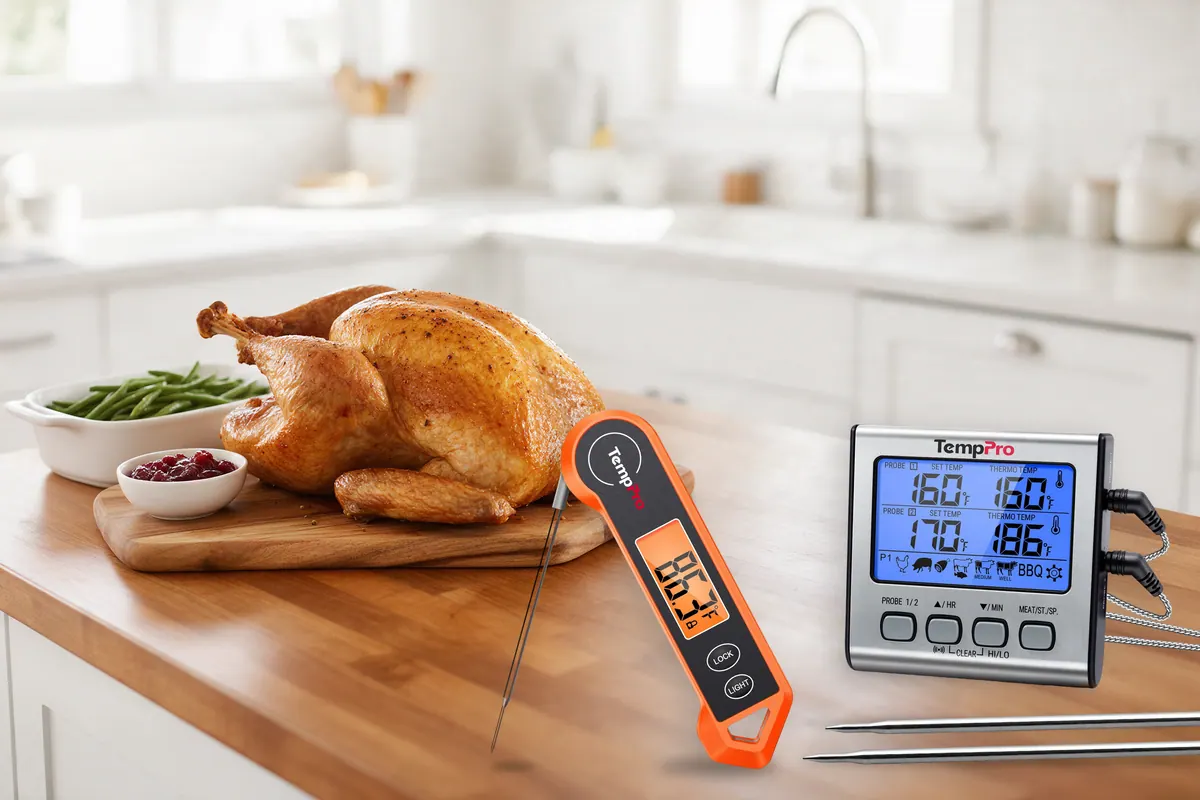
The best meat thermometer for turkey is an oven-safe leave-in probe thermometer, because it reads the thickest part of the thigh the whole time the bird roasts and beeps at your target without you opening the oven. Our pick is the TempPro TP17, a dual-probe model, so one probe can track the thigh and the other the breast. Back it up with an instant-read such as the TempPro TP19H to check the wing and breast at 165°F before you carve.
This is a research-based guide built from USDA food-safety guidance and TempPro’s specifications and manuals, not hands-on testing. TempPro is the new name ThermoPro announced on April 8, 2026; the model numbers didn’t change, and your box may still say ThermoPro.
Why a turkey needs a real thermometer
A turkey is the hardest thing on the Thanksgiving table to judge by eye. USDA says a whole turkey is safe at a minimum internal temperature of 165°F, and that you should check it in three places: the innermost part of the thigh, the innermost part of the wing and the thickest part of the breast. Color and juices don’t tell you that. USDA’s food thermometer guidance calls a thermometer the only reliable way to know food has reached a safe temperature.
The pop-up button that comes in many birds isn’t a substitute either. USDA recommends checking the thigh, wing and breast with a food thermometer even when the turkey has a pop-up indicator. If you stuff the bird, the center of the stuffing must also reach 165°F, which is one more reading to take. USDA’s own advice is to bake the stuffing separately in a casserole.
How to choose a meat thermometer for turkey
Look at four things:
- Can it stay in the oven? A leave-in probe on a heat-rated cable (USDA calls this an oven cord thermometer) sits in the thigh from the start and alarms at your target. Instant-read thermometers are not designed to stay in food while it cooks, per USDA, so they only check at the end.
- How many probes? Breast meat and thigh meat finish at different times. Two probes let you watch both, or watch the meat and the oven air at once.
- A poultry preset and an alarm. On a day with four timers going, a thermometer that beeps at 165°F means you aren’t opening the oven every 20 minutes and losing heat.
- Can you check its accuracy? USDA’s ice-water test should read 32°F. Some thermometers can be recalibrated if they’re off; USDA says oven cord thermometers can’t.
Leave-in vs. instant-read thermometers for turkey
| Feature | Leave-in oven-cord probe (TempPro TP17) | Instant-read (TempPro TP19H) |
|---|---|---|
| Stays in the turkey while it roasts | Yes; the base sits outside the oven | No; spot checks only |
| Probes | 2, on braided stainless cables | 1 folding probe |
| Alarm | Target temperature per probe, plus a HI/LO range alarm for smokers and grills | None; lock button holds the reading |
| Poultry preset | 165°F | Not applicable |
| Rated accuracy | ±1.8°F (14°F to 572°F) | ±0.9°F (14°F to 212°F) |
| Recalibration | No; USDA says oven-cord thermometers can’t be calibrated | Yes, in ice water |
| Water exposure | Don’t submerge probes or cables | IP65; rinse under running water, don’t immerse |
| Best job on Thanksgiving | Watching the thigh and breast the whole roast | Confirming the wing, breast and stuffing before carving |
Best leave-in for the oven: TempPro TP17
The TempPro TP17 (sold on Amazon as the TempPro TempTrack dual-probe thermometer) is an oven-cord thermometer: two stainless probes on braided steel cables run out of the oven door to a base with a backlit screen. TempPro’s spec sheet lists 8-inch probes, 49-inch total cable length, readings that refresh every second, and a range of 14°F to 572°F at ±1.8°F.
For a turkey, the two probes are the point. Set Probe 1 to the poultry preset, which TempPro’s manual lists at 165°F, and put it in the thickest part of the inner thigh, the spot USDA recommends for a leave-in thermometer. Put Probe 2 in the thickest part of the breast. Each probe has its own target and alarm, so you hear when each part gets there. TempPro’s manual says to insert the tip at least 2 inches into the thickest part of the meat, not near bone or gristle, and to leave enough slack in the cable that closing the door doesn’t pull the probe out.
The second probe can also watch the oven or smoker instead of the meat. In BBQ mode it has a HI/LO range alarm that beeps if the cooker drifts out of the range you set, which helps if your turkey is going on a smoker or pellet grill. TempPro’s manual says that with a probe sitting in the oven air rather than in food, readings above 200°F are accurate to within 2°F to 5°F. That makes it a useful way to test-run an oven you suspect is running hot or cold before the holiday.
Know the limits before you rely on it:
- The base unit is not oven-safe. It stays outside on a stable surface, never on a hot cooktop, held by its magnets or flip-out stand.
- TempPro says not to expose the probes to oven temperatures above 716°F, to keep them out of direct flame and off the heating elements, and not to touch a hot probe or cable without a heat-resistant glove.
- Clean the probes with hot soapy water, but don’t submerge the probes or cables. TempPro’s manual says the probe-to-cable connection is not waterproof.
Best instant-read for spot checks: TempPro TP19H
The TempPro TempSwift TP19H is a folding instant-read thermometer. TempPro rates it at ±0.9°F from 14°F to 212°F, the range that covers 165°F poultry, with a full range of -58°F to 572°F. The display is backlit and rotates for either hand, a lock button holds the reading so you can read it away from the heat, and the probe can be recalibrated in ice water if it drifts. TempPro rates the body IP65, so you can rinse it under running water, but its manual says not to immerse it or put it in the dishwasher.
On Thanksgiving it does the jobs a leave-in probe can’t. When the TP17’s thigh alarm goes off, pull the pan out and use the TP19H on the innermost part of the wing and the thickest part of the breast, which USDA says should also reach 165°F. It also takes the temperature of the stuffing, a casserole (also 165°F per USDA) or reheated leftovers, and it travels if you’re cooking at someone else’s house.
Know the limits before you rely on it:
- TempPro’s manual says the TP19H is for temporary hand-held use and not to use it in an oven or leave it in food while cooking. Open the oven or pull the pan to take a reading.
- The manual warns not to touch the stainless probe during or right after a reading, because it will be very hot.
- It has a built-in magnet. TempPro tells pacemaker users to keep it at least 1 foot (0.3 m) away.
- TempPro’s product page lists a 3-year warranty after you register it.
How to take a turkey’s temperature the right way
- Check your thermometers a day ahead. Do USDA’s ice-water test: a glass full of ice with drinking water, the probe at least 2 inches in without touching the glass, then wait 30 seconds. It should read 32°F. Recalibrate the instant-read if it’s off.
- Set the oven no lower than 325°F, per USDA, and use USDA’s roasting chart only as an estimate. A 14- to 18-pound unstuffed turkey runs about 3¾ to 4¼ hours at 325°F.
- Insert the leave-in probe at the start into the thickest part of the inner thigh, away from bone, as USDA recommends. Add a second probe in the thickest part of the breast if you have one, and leave cable slack before you close the door.
- Let the alarm do the watching. Opening the oven door to check the bird lets heat out and stretches the cook time.
- When the thigh hits 165°F, confirm the rest. Use the instant-read in the innermost part of the wing and the thickest part of the breast. If you stuffed the bird, check the center of the stuffing too.
- Rest it. USDA suggests letting the turkey stand 20 minutes before carving so the juices set, then remove all stuffing from the cavity.
If the bird is going into a roaster oven or onto an electric smoker, the same probe placement applies. If you’re frying the turkey, follow that guide’s oil and safety rules instead. And if the oven itself won’t hold temperature or shows a code on the day, see our guides to an electric oven not heating and Samsung oven error codes.
Thanksgiving thermometer checklist
- Want the oven closed and an alarm at 165°F? Get a leave-in oven-cord probe like the TempPro TP17, and use both probes for thigh and breast.
- Want to confirm the wing, breast and stuffing before carving? Add an instant-read like the TempPro TP19H, and never leave it in the oven.
- Test both in ice water the day before; it should read 32°F.
- Keep the TP17’s base outside the oven and its cables away from flame and heating elements.
- Don’t trust a pop-up timer alone; USDA says to verify with a thermometer.
- Get leftovers into the refrigerator within 2 hours, and reheat them to 165°F.
Tools and supplies mentioned
TempPro TempTrack TP17 Dual-Probe Leave-In Meat Thermometer
by TempPro
An oven-cord thermometer with two oven-safe stainless probes on braided cables, a poultry preset of 165°F, a target-temperature alarm and a timer. One probe can sit in the thigh and the other in the breast for the whole roast.
Fit check: The base stays outside the oven. TempPro says not to expose the probe to oven temperatures above 716°F, direct flame or the heating elements, and not to submerge the probes and cables.
TempPro TempSwift TP19H Instant-Read Meat Thermometer
by TempPro
A folding instant-read thermometer rated to ±0.9°F between 14°F and 212°F, with an auto-rotating backlit display, a lock button and ice-water recalibration. Use it to confirm the wing and breast before the bird comes out.
Fit check: For hand-held spot checks only. TempPro says not to leave it in food while cooking or use it in an oven. It has a built-in magnet, so the manual tells pacemaker users to keep it at least 1 foot away.
Frequently asked questions
Where do you put a meat thermometer in a turkey?
USDA says to check a whole turkey in three places: the innermost part of the thigh, the innermost part of the wing and the thickest part of the breast, without touching bone. A leave-in probe goes in the thickest part of the inner thigh at the start; once that reads 165°F, check the wing and breast.
What temperature should a turkey be when it's done?
USDA's safe minimum for turkey, including the stuffing, is 165°F. You can cook it hotter for texture, but not lower. Let the bird stand about 20 minutes before carving so the juices set.
Can you leave an instant-read thermometer in the turkey while it roasts?
No. USDA says instant-read thermometers aren't designed to stay in food while it cooks, and TempPro's TP19H manual says not to use it in an oven. Use a leave-in oven-safe probe for the whole roast and the instant-read for spot checks at the end.
Is the pop-up timer in my turkey enough?
USDA recommends also checking the thigh, wing and breast with a food thermometer even if the turkey has a pop-up indicator, because placement matters and every part needs to reach 165°F.
How do I check if my meat thermometer is accurate?
Use USDA's ice-water test: stir ice and water in a glass, hold the probe at least 2 inches in without touching the sides, and wait 30 seconds. It should read 32°F. The TP19H can be recalibrated in ice water; USDA says oven-cord thermometers like the TP17 can't be calibrated, so replace one that reads off.
Is TempPro the same as ThermoPro?
Yes. ThermoPro announced on April 8, 2026 that it was renaming itself TempPro, with the same products and model numbers. TempPro says orders may still arrive in ThermoPro-branded packaging.
Sources
- USDA FSIS: Let's Talk Turkey, A Consumer Guide to Safely Roasting a Turkey
- USDA FSIS: Food Thermometers
- TempPro: TempTrack PLUS TP17 Leave-In Meat Thermometer
- TempPro: TP-17 instruction manual (PDF)
- TempPro: TempSwift PLUS TP19H Instant-Read Meat Thermometer
- TempPro: TP19H instruction manual (PDF)
- PR Newswire: ThermoPro Becomes TempPro (April 8, 2026)