Refrigerator in the Garage in Winter: Why It Stops Cooling and What to Do
A standard refrigerator in a cold garage can stop running, so the freezer thaws. Check your model's rated range, use garage settings, and protect your food.
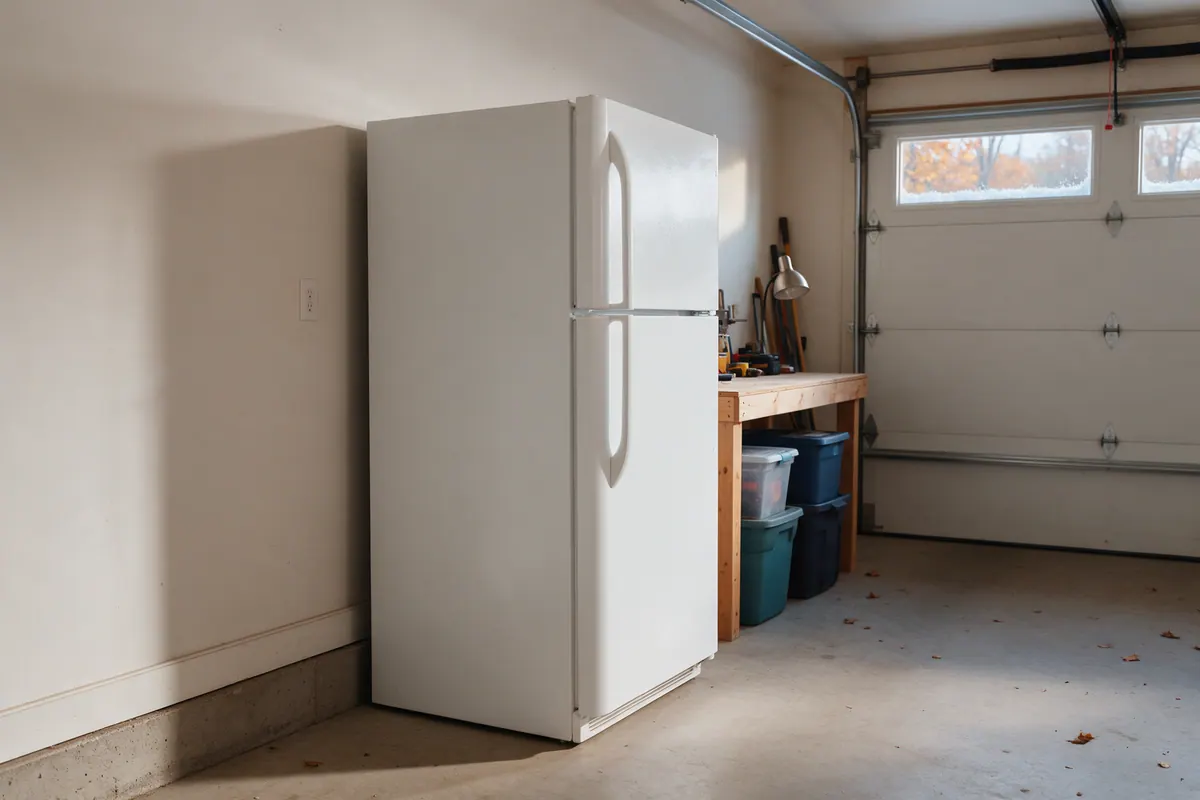
A standard refrigerator in the garage in winter can stop cooling because the cold room air tricks it into running less, or not at all, so the freezer warms up and food can thaw. Many standard indoor refrigerators are only rated for rooms down to about 55 or 60°F (13 to 16°C); GE says that at 32°F (0°C) there may be no cooling at all. Check your model’s rated range in the manual, use a garage or cold-weather setting if it has one, and move a standard unit indoors when the garage gets colder than it’s built for.
It’s a common surprise: the garage is freezing, so the second fridge should be fine, right? The opposite is true, and it shows up most in the first cold snaps of November through January. Here is why it happens and what to do before it costs you a freezer full of food.
Why a cold garage makes a refrigerator stop cooling
A refrigerator doesn’t make cold; it moves heat out of the cabinet. GE explains that the refrigeration system relies on refrigerant boiling under pressure and heat. If the air around the unit isn’t warm enough, the refrigerant won’t boil to a vapor and no cooling takes place.
The bigger problem in most homes is the thermostat. GE says low temperatures can fool the thermostat into thinking the right temperature has been reached. KitchenAid describes the result: in cold weather a standard refrigerator may cycle less or not at all, because the ambient air masks the need for cooling, and the freezer warms and can thaw. The fresh-food side may feel fine, or even too cold, while the ice cream turns soft.
Cold is also hard on the hardware. Per GE, below 32°F the compressor oil can thicken and not circulate properly. Heat matters too: above 110°F (43°C), the oil can overheat and break down. That’s why manufacturers give a rated range, not just a minimum.
What temperature is too cold for a garage refrigerator?
It depends on the model, so the owner’s manual or installation instructions are the final word. Here is what the makers themselves publish:
| Appliance | Rated room temperature | Source |
|---|---|---|
| Whirlpool standard indoor refrigerator | 55 to 110°F (13 to 43°C) | Whirlpool Product Help |
| GE standard refrigerator | Not recommended below 60°F (16°C) unless the manual says otherwise | GE Appliances |
| GE garage-ready top-freezer refrigerator | 38 to 110°F (3 to 43°C) | GE Appliances |
| KitchenAid garage-ready models with Garage Mode | Garage Mode for 38 to 55°F; Recommended setting for 55 to 110°F | KitchenAid Product Help |
| Frigidaire FFUE1626AV garage-ready convertible upright freezer | 0 to 110°F as a freezer; 38 to 110°F as a refrigerator | Frigidaire |
Two things stand out. Even a garage-ready refrigerator usually has a floor around 38°F, so a garage that drops into the 20s can be too cold for it too. And a garage-ready freezer can be rated much lower than a refrigerator, as the Frigidaire example shows, so check the freezer’s own rating rather than assuming it matches a refrigerator’s. If you’re still choosing one, our chest vs. upright freezer guide covers the garage question.
Winter garage refrigerator checklist
| Task | How often |
|---|---|
| Look up your model’s rated temperature range | Once, before the first cold snap |
| Check garage temperature on cold mornings | Through the cold months |
| Check fridge and freezer with appliance thermometers | Weekly in cold weather |
| Switch Garage Mode or cold settings on or off | When the garage moves in or out of the rated range |
| Clean door gaskets and condenser coils | As your manual directs; see the maintenance calendar |
Check your model’s rated temperature range
Find the model number (it’s usually on a label inside the fresh-food compartment), then look up the manual on the maker’s site. Search it for “installation location,” “ambient,” or “garage.” If it gives a minimum such as 55°F or 60°F, assume that’s a hard line for winter. If it says garage-ready, note the lowest temperature it lists and whether there’s a special setting.
GE’s garage-ready top-freezer models can be spotted by a “Dual Temp Control” option on the freezer air tower, according to GE.
Measure the garage and the compartments
- Put an inexpensive thermometer in the garage near the refrigerator and read it early in the morning, when it’s coldest.
- Put an appliance thermometer in the fresh-food section and another in the freezer. The USDA says to keep the refrigerator at 40°F (4°C) or below and the freezer at 0°F (-18°C).
- Watch the freezer reading, not just the fridge. A thawing freezer is the classic winter garage symptom.
KitchenAid suggests set points of about 37°F for fresh food and 0°F for the freezer.
Use the garage or cold-weather setting (if your model has one)
Settings are model-specific, so follow your own manual. Two published examples:
- KitchenAid garage-ready models with Garage Mode: use Garage Mode when the room is consistently between 38 and 55°F. Leave it on the factory Recommended setting from 55 to 110°F, and switch back when the weather warms so the unit runs efficiently.
- GE garage-ready top-freezer models: for cold conditions between 38 and 54°F, GE says to set the refrigerator to setting 2 (to keep fresh food from freezing) and the freezer to position 5 (to keep frozen food from thawing). These numbers apply to those GE models only, not to other brands.
A standard refrigerator without a garage setting doesn’t have a safe workaround. Turning the dial colder won’t fix it, because the problem is that the room is too cold for the thermostat to call for cooling.
Move a standard refrigerator indoors, or empty it
If your garage regularly falls below the model’s rated minimum, the practical choices are:
- Move it to a basement, utility room, or other space that stays in range.
- Empty it and unplug it for the season if you can do without it until spring.
- Replace it with a model rated for the space when it’s time for a new one, such as a garage-ready refrigerator or a garage-ready freezer if frozen storage is what you need.
What to do with food if the freezer thawed
The USDA’s rule of thumb: if food is partly frozen, still has ice crystals, or is as cold as a refrigerator (40°F or below), it’s safe to refreeze or use. Discard food that has been warmer than 40°F for more than 2 hours, and anything contaminated by raw meat juices. Melted ice cream is a quality loss, not a safety one, but the USDA suggests tossing it.
For refrigerated food that got warm, use the FoodSafety.gov keep-or-discard chart. When in doubt, throw it out, and never taste food to decide.
Keep up the routine maintenance
KitchenAid’s tips for garage-ready refrigerators apply to any second fridge:
- Clean the door gaskets so they seal tightly, and replace them if they’re torn.
- Vacuum or brush the condenser coils as the manual directs.
- Make sure the refrigerator is level so the doors close and drain properly.
- Don’t overpack it; leave room for air to circulate around shelves, vents, and sensors.
Our refrigerator maintenance checklist walks through each of these.
Signs it’s time for a repair
Cold weather explains a lot of winter garage problems, but not all of them. Have the refrigerator checked if:
- It still isn’t cooling after it has been moved into a room within its rated range and given a day to settle.
- The compressor runs constantly but neither compartment gets cold.
- It struggles in summer heat too, which points to a problem beyond the winter cold.
Start with the easy checks in our refrigerator not cooling guide, and leave anything inside the sealed refrigerant system to a qualified technician.
Step-by-step summary
- Find your model's rated temperature range. Look up the minimum and maximum room temperature in the owner's manual or installation instructions. Standard indoor refrigerators are often rated to about 55 or 60 degrees F; garage-ready models go lower.
- Measure the garage and the compartments. Check the garage temperature on cold mornings, and put appliance thermometers in the fresh-food and freezer sections. The USDA says the refrigerator should be at 40 degrees F or below and the freezer at 0 degrees F.
- Switch to the cold-weather setting if your model has one. On models with a Garage Mode or cold-ambient setting, use it only when the garage stays in the range the manufacturer gives, and switch back when it warms up.
- Move a standard refrigerator indoors when the garage is too cold. If the garage drops below the model's rated minimum, relocate the unit or empty it. Don't add aftermarket garage or heater kits, which GE says should not be used.
- Check frozen food after a thaw. Food that still has ice crystals or is at 40 degrees F or below can be refrozen, per the USDA. Throw out food that has been warmer than 40 degrees F for more than 2 hours.
- Do the routine upkeep. Clean the door gaskets, vacuum the condenser coils as the manual directs, and make sure the unit is level so the doors seal.
Frequently asked questions
Can a refrigerator be kept in a cold garage in winter?
Only if its manual says it can run that cold. Whirlpool rates its standard indoor refrigerators for 55 to 110 degrees F, and GE does not recommend a standard refrigerator where it drops below 60 degrees F. Garage-ready models are rated lower, such as GE's garage-ready top-freezer models at 38 to 110 degrees F.
Why does my garage freezer thaw when it's cold outside?
On most combination refrigerator-freezers, cold room air keeps the cabinet cold enough that the unit runs less or stops, so the freezer section warms up. KitchenAid says a standard unit in cold weather may cycle less or not at all, causing the freezer to warm and potentially thaw.
What temperature is too cold for a refrigerator in the garage?
It depends on the model, so check the manual. GE says a standard refrigerator loses efficiency below 60 degrees F and may have no cooling at all at 32 degrees F, while garage-ready top-freezer models are rated down to 38 degrees F.
Can I use a heater kit to keep my garage refrigerator running?
GE says aftermarket garage kits or heater kits should not be used with its refrigerators. If the garage gets colder than your model's rated range, move the refrigerator indoors or switch to a model rated for the space.
Is a garage-ready freezer different from a garage-ready refrigerator?
The rated ranges can differ. Frigidaire's garage-ready convertible upright freezer FFUE1626AV is rated for 0 to 110 degrees F in freezer mode but 38 to 110 degrees F in refrigerator mode, so always check the range for the mode you use.
Is food safe if my garage freezer thawed?
Food that still has ice crystals or is 40 degrees F or below is safe to refreeze or use, according to the USDA. Discard anything that has been warmer than 40 degrees F for more than 2 hours.
Sources
- GE Appliances: Refrigerator - Installation Location and Temperature
- GE Appliances: Top Freezer Refrigerator - Garage Ready Models
- KitchenAid Product Help: How Garage-Ready Refrigerators Work
- Whirlpool Product Help: Not Cooling (Refrigerator)
- Frigidaire: 16 Cu. Ft. Garage Ready Convertible Upright Freezer (FFUE1626AV)
- USDA FSIS: Freezing and Food Safety
- FoodSafety.gov: Food Safety During Power Outage