Under-Counter Fridge for a Wet Bar or Coffee Station: Refrigerator vs. Beverage Cooler
For milk, cream or fruit at a wet bar or coffee station, buy a true under-counter refrigerator that holds 40°F or below, not a wine or thermoelectric cooler.
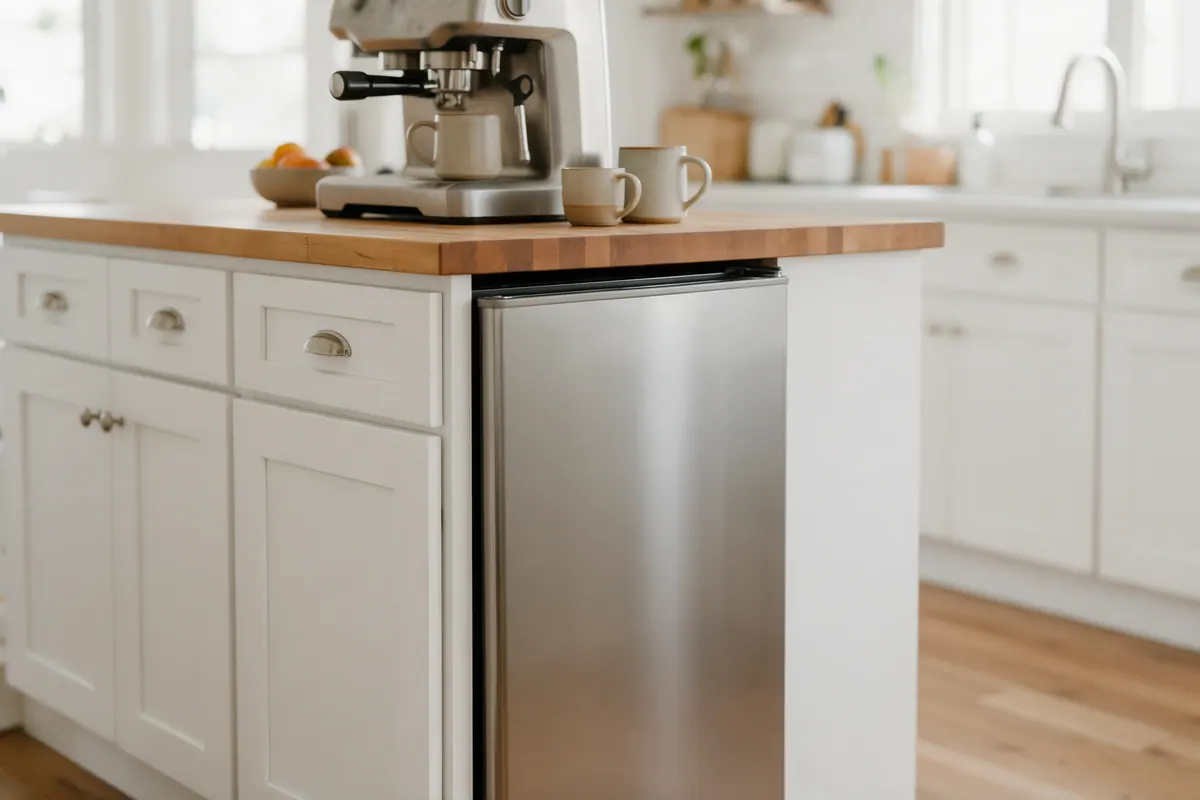
If your under-counter fridge for a wet bar or coffee station will hold milk, creamer, cut fruit or anything else perishable, buy a true under-counter refrigerator that can hold 40°F (4°C) or below, not a wine cooler or a thermoelectric beverage cooler. If it will only hold cans, bottles and wine, a beverage center is fine. For a flush fit inside cabinets, choose a model built for under-counter installation with a front vent; a freestanding mini fridge needs open air around it.
That one decision, food or drinks only, settles most of the choice. The rest is fit, door swing, alarms and service. Here is what to check before you buy.
Refrigerator vs. beverage cooler vs. wine cooler at a glance
| Under-counter refrigerator | Beverage center | Wine cooler (compressor) | Thermoelectric cooler | |
|---|---|---|---|---|
| Built for | Food and drinks | Cans, bottles, some wine | Wine | Small amounts of wine or drinks |
| Interior | Shelves, door bins, sometimes drawers | Can and bottle racks, glass shelves | Wine racks | Racks or a single shelf |
| Can it hold 40°F or below? | Yes, that is the job | Often, in the beverage zone; check the spec | Usually not; wine zones run warmer | Depends on room temperature; often not |
| Good for milk and fruit? | Yes | Only in a zone verified at 40°F or below | No | No |
| Typical install | Built-in (front vent) or freestanding | Built-in or freestanding | Built-in or freestanding | Freestanding |
The ranges behind that table come from makers’ own specs. U-Line lists a 34 to 70°F range for its undercounter refrigerators, which reach food-safe temperatures and can also run warmer for other items. JennAir’s RISE 24-inch beverage center (JUBFR242HL) has one zone that runs 33 to 40°F and a wine zone that runs 42 to 64°F, so only half of that cabinet can hold food-safe temperatures.
Why the 40°F line matters for a coffee station
The FDA says a refrigerator should stay at 40°F (4°C) or below. USDA’s Food Safety and Inspection Service (FSIS) notes that harmful bacteria grow slowly below 40°F and multiply rapidly between 40 and 140°F. It also says foods held above 40°F for more than 2 hours should not be eaten.
Milk, half-and-half, creamer, yogurt and cut fruit are exactly the foods that rule covers. A wine cooler that bottoms out in the 40s is a good place for wine and a poor place for the milk next to your espresso machine. Thermoelectric coolers are a bigger problem, because how cold they get depends on the room. Summit’s manual for its STC1 thermoelectric wine cooler lists a 46 to 66°F control range and a maximum difference of 31°F between the room and the inside of the cooler. It recommends a room between 50 and 80°F. That cooler can never reach 40°F, however you set it.
Built-in or freestanding: check the venting first
This is the most common under-counter mistake. A refrigerator makes heat and has to get rid of it.
- Built-in under-counter models breathe through a grille at the front, near the floor. KitchenAid says built-in beverage centers typically use front venting, with all airflow through the front grille, and that the grille must stay completely clear. These are the models designed to slide into a cabinet opening with cabinets on both sides.
- Freestanding compact fridges and coolers usually need open space around the back or sides. Read the installation section of the manual before you buy. If it asks for clearance at the back and sides, the unit is meant to stand in the open, at the end of a counter run or on a bar top, and boxing it into a cabinet can make it run warm and work harder.
If you want the sleek, flush look you see in kitchen remodel ads, you are shopping for a built-in, front-vented model. If you are adding a fridge to a guest room, office or the end of a counter, a freestanding unit can work as long as it gets the air space its manual asks for.
Measure the opening, not just the width
Built-in under-counter models are sized to slide into a base-cabinet opening, and 24 inches is a common width. Height and depth matter just as much:
- Measure the opening height from the finished floor to the underside of the countertop.
- Measure the width at the top and bottom of the opening, and the depth from the back wall to the front of the cabinet face.
- Compare those numbers with the model’s installation guide, not just the product dimensions. The guide lists the cutout size, any required gaps, and where the power outlet should be.
For reference, Whirlpool lists its 24-inch WUR50X24HZ at 34.5 in high, 23.94 in wide and 25.63 in deep. KitchenAid lists its 24-inch KURR124SSB at 34.38 in high, 23.87 in wide and 26.43 in deep. Those small differences are why the installation guide is the document to check.
Door swing, hinges and noise
- Door swing. Open the door toward where you will stand. Whirlpool says the WUR50X24HZ has a reversible door that can go on either side. KitchenAid sells the KURR124SSB as a right-swing model; it uses hidden hinges so the door sits flush with the cabinet fronts and opens to 115 degrees. If your model is not reversible, buy the hinge side you need.
- Glass or solid door. A glass door shows off bottles. A solid door hides a carton of milk and a fruit bowl, which is the look most coffee stations want.
- Noise. An under-counter fridge often sits near a seating area or a bedroom. Makers rarely publish a sound rating for these models, so read the manual’s “normal sounds” section and the reviews for fan and compressor noise before you buy one for a quiet room.
Alarms are worth paying for, especially for older users
A small fridge tucked under a counter is easy to forget about. Temperature and door alarms catch problems before the milk does:
- KitchenAid says the KURR124SSB sounds an over-temperature alarm if it detects more than 45°F for more than 4 hours. It also has a door alarm that sounds if the door has been open for five minutes or more.
- Whirlpool says the WUR50X24HZ has a temperature sensor alert that warns you if the temperature is rising or cold air is escaping through an open door.
If you are setting up a coffee station near a parent’s room, an alarm and a clearly readable thermometer on the top shelf are worth more than extra capacity.
Reliability and service: what you can actually check
There is no reliable public data that ranks under-counter fridge brands by failure rate, so be wary of sites that claim one. What you can check before you buy:
- Compressor vs. thermoelectric. For food storage, choose a compressor refrigerator. Thermoelectric cooling depends on room temperature, as Summit’s manual shows.
- Warranty terms. Read what is covered and for how long, including the sealed system (compressor and refrigerant lines).
- Service access. A built-in unit has to come out of its cabinet for many repairs. Ask whether an authorized technician services that brand in your area.
- Recalls. Look up the exact model number on the CPSC recall site before buying a used or older unit. Our Galanz retro refrigerator recall guide shows how to read a model and date-code label.
Under-counter fridge buying checklist
- Will it hold perishables? If yes, it must hold 40°F (4°C) or below.
- Compressor cooling, not thermoelectric, for anything perishable.
- Built-in install? Front-vented model rated for under-counter use.
- Opening measured and checked against the installation guide’s cutout size.
- Door swing matches the room, or the door is reversible.
- Solid or glass door, depending on what you want to show.
- Temperature and door alarms, especially for older or forgetful users.
- Outlet location and cord length checked.
- Warranty terms and local service confirmed.
- An appliance thermometer ready for the first week.
After it is installed
Give a new fridge time to cool down before loading it, and follow the manual’s start-up instructions. Then check the temperature the way USDA FSIS recommends: put an appliance thermometer in a glass of water in the middle of the fridge, wait 5 to 8 hours, and adjust the control if it is not reading 38 to 40°F. Check again after another 5 to 8 hours.
Once it is running, the same care applies as for a full-size fridge. Our refrigerator maintenance checklist covers seals and coils, and if it ever starts running warm, start with why a refrigerator stops cooling. If the fridge will live in an unheated space, read what happens to a refrigerator in a cold garage first, since that applies to compact units too.
Tools and supplies mentioned
Taylor Analog Refrigerator Freezer Thermometer (5924)
by Taylor
A simple dial thermometer to confirm a new under-counter fridge actually holds 40°F (4°C) or below before you trust it with milk, cream or cut fruit.
Fit check: Hangs from a wire shelf or stands on a glass shelf; reads -20 to 80°F, so it works in any small refrigerator or beverage cooler.
Frequently asked questions
Can a beverage fridge keep milk cold enough?
Only if it can hold 40°F (4°C) or below and you confirm that with a thermometer. Many wine coolers bottom out in the mid 40s, and a thermoelectric cooler may not get that cold at all in a warm room, so they are not a safe place for milk or cream.
What temperature should an under-counter fridge be for food?
The FDA says a refrigerator should stay at 40°F (4°C) or below, and USDA FSIS suggests aiming for 38 to 40°F. Check it with an appliance thermometer, because most controls show a setting, not the real temperature.
Can I put a freestanding mini fridge under a counter?
Only if its installation instructions allow it. Built-in under-counter models are designed to breathe through a front grille, while a unit that needs open space at the back and sides can overheat and struggle to stay cold when it is boxed into a cabinet.
What is the difference between an under-counter refrigerator and a beverage center?
An under-counter refrigerator is a small general-purpose fridge with shelves and bins for food and drinks. A beverage center is built around cans and bottles and often has a warmer wine zone, so check which zones can actually reach food-safe temperatures before storing food in one.
How tall is a standard under-counter refrigerator?
Most 24-inch built-in models are sized for a standard base cabinet opening. For example, Whirlpool lists its WUR50X24HZ at 34.5 inches tall and KitchenAid lists its KURR124SSB at about 34.4 inches, but always measure your opening and read the model's installation guide.
Sources
- FDA: Refrigerator Thermometers, Cold Facts about Food Safety
- USDA FSIS: Appliance Thermometers
- USDA FSIS: Refrigeration and Food Safety
- U-Line: Undercounter Beverage Center vs. Refrigerator, What's the Difference?
- KitchenAid: Beverage Center Dimensions Guide
- JennAir: RISE 24-Inch Built-In Undercounter Beverage Center (JUBFR242HL)
- Summit Appliance: STC1 Thermoelectric 8-Bottle Wine Cooler Instruction Manual
- KitchenAid: 24-Inch Undercounter Refrigerator KURR124SSB
- Whirlpool: 24-Inch Wide Undercounter Refrigerator WUR50X24HZ